










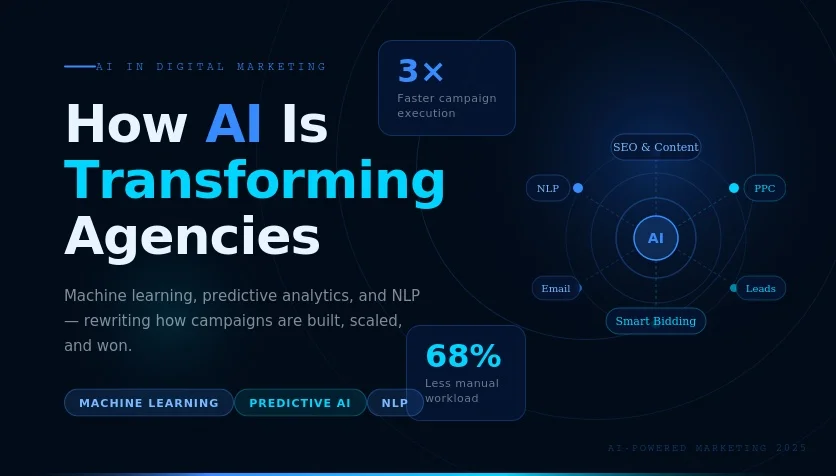
Key Takeways:
- Enables faster data analysis and decision-making.
- Improves customer targeting and customisation.
- Reduces manual workload for agencies.
- Human ingenuity remains crucial with AI.
- AI enables agencies to scale marketing operations faster.
How AI Is Transforming Digital Marketing for Agencies
AI for Marketing Agencies is the use of artificial intelligence to plan, execute or optimize a company marketing efforts. It also refers to improve technologies like machine learning, automate marketing tasks, natural language processing and make data-driven decisions. It has three core capabilities:
- Machine Learning
- Natural Language Processing
- Predictive Analytics
Machine Learning: Machine Learning is one of the most significant types of AI marketing. This models find patterns in historical and live data, who clicks, who buys, which creative lifts conversions. It also covers recommendation systems, predictive analytics and customer segmentation.
Natural Language Processing: Natural Language Processing reads and generate human language to draft copy, summarize chats and classify intent or leads to the right next step. It equips with the skills to understand the way how we talk and communicate back in a human-like way.
Predictive Analytics: The practice of transforming historical data into a financial crystal ball. Agencies can predict market movements, forecast campaign ROI, and map out client behavior before it occurs by deciphering previous consumer trends.
Why Agencies are Adopting AI?
AI for Marketing Agencies is significant since it speeds and improves the efficiency. Models automate monotonous activities, tailor messaging to each client, and adjust offers and creatives in real time based on results.
Faster Campaign Execution
Historically, starting an omnichannel marketing campaign required weeks of cross-departmental collaboration. AI condenses this timeframe into hours or minutes.
- Rapid Asser Generation
- Instant Onboarding and Deployment
Improved Data Analysis
Human analysts are restricted in their ability to process rows of data. AI excels at detecting patterns hidden within millions of data pieces in real time.
- Predictive Performance Insights
- Automated Audits and Pitch Decks
Better Customer Targeting
Traditional demographic buckets are being replaced with hyper-specific behavioral-intent modeling.
- Lookalike and Predictive Audiences
- Dynamic Intent Matching
Reduced Manual Work
AI functions as a digital workforce, taking over the monotonous, soul-crushing activities that consume an account manager’s day.
- Automation of Routine Tasks
- AI-Driven Customer Care
Increased Marketing Efficiency
By maximizing every dollar every hour spent, AI enhances campaign Return on Ad Spend and agency profitability.
- Algorithmic Budget Pacing
- Lower Cost-Per-Acquisition
Scalable Marketing Operations
The ultimate benefit of AI adoption is that it decouples an agency’s revenue from its manpower. It enables you to handle enormous workloads without experiencing operational downtime.
- Uncapped Client Capacity
- Standardized Quality Control
AI Applications in Digital Marketing
AI technologies have become more accessible and easier to use, companies have started to use them in daily tasks.
Generative AI for content and image creation
Creating a good content takes time and effort. Marketing teams are under pressure to create content quickly so, AI copywriting tool such as ChatGPT and Claude helps people to generate content. You can also get prompts, catchy headlines and customize your content. It will be useful to boost your influencer marketing campaigns and manage relationship.
Search Engine Optimization
AI has changed the rules of organic visibility by combining deep research and high-volume content generation into real-time workflows, allowing growing companies to sidestep traditional publication authorities. As advanced search engines transition from static list crawling to real-time synthesis, machine insights serves as the equalizer, permitting brand assets to secure crucial real estate in AI Overviews, voice request, and multi-modal visual search ecosystems.
Pay-Per-Click advertising
Pay-Per-Click is one form of advertising where you pay when someone clicks your ad. It is important to attract new customers through targeted campaigns and get quick results. PPC campaigns by:
- Conduct keyword research
- Create compelling copy with Generative AI
- Refine audience targeting
- Improve bidding strategy
- Create responsive landing pages
- Optimize product tiles and descriptions
- Fraud detection
- Automate A/B testing
Email Marketing
Email marketing is a vital component of any marketing plan since it remains an efficient implies to convert prospects and engage clients. Utilizing AI techniques in e-mail marketing can offer assistance you save time and improve results.
Benefits if using AI emails:
- Analyze email performance
- Conduct triggered workflows
- Craft copy tailored to audience
- Conduct campaign and workflow analysis
- Determine the optimal send frequency
- Clean and curate email lists
Challenges of using AI in Digital Marketing
AI is as good as the data fed into it whereas the poor quality data would have an algorithm to produce false results.
Data Privacy and Regulatory Compliance
While machine intelligence gives unparalleled depth in client encounters, it also imposes strict obligations in terms of information sovereignty and corporate morals. Exploring this landscape requires balancing rapid technological development with robust information protection frameworks.
- Strict Regulatory Guardrails
- Data Leakage Risks
Intellectual Property and Copyright Uncertainty
The biggest risk of using generative AI in Digital Marketing agencies is regarding intellectual property and copyrights. Brand search AI for research and inspiration but not blindly use AI-generated texts and images.
- Ownership Vulnerabilities
- Inadvertent Plagiarism
Factual Inaccuracies and Hallucinations
AI models utilize probabilistic language production, which implies they prioritize making writing sound powerful over factual accuracy.
- The Hallucination problem
- Data Drift
Content Saturation and Diluted Brand Voice
Because AI tools make content creation simple, the internet is inundated with highly generic, formulaic marketing text.
- Loss of Human Nuance
- Search Engine Countermeasures
Technical Implementation cost and Black Box Algorithms
Integrating complex machine learning models necessitates considerable upfront investments, and determining why the AI makes certain conclusions is quite tough.
- The Black Box Dilemma
- Hidden Tech-Stack Costs
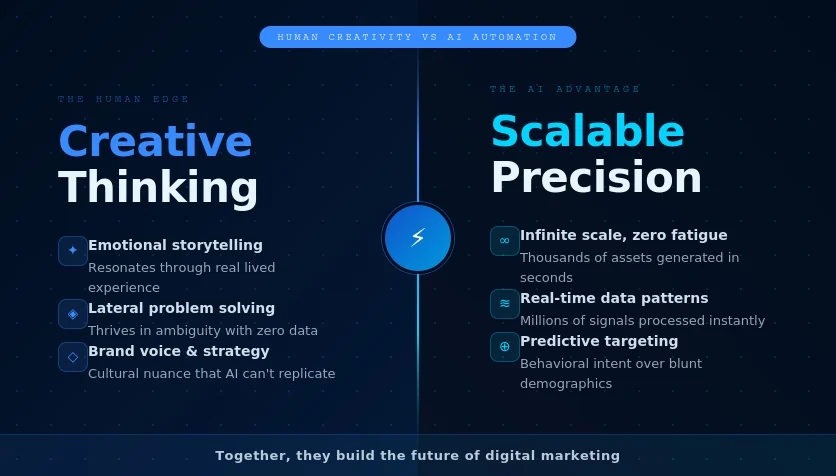
Core Comparison: Human Creativity vs. AI Automation
|
Dimension |
Human Creativity |
AI Automation |
|---|---|---|
| Origin & Drive | Driven by intrinsic motivation, lived experiences, emotional states, and a desire to connect or express. | Driven by algorithmic prompts, mathematical optimization, and statistical probabilities found in training data. |
| Problem Solving | Lateral thinking. | Vertical thinking. |
| Handling Novelty | Thrives in ambiguity. Can create something meaningful when there is zero historical data. | Relies on historical data. Struggles or “hallucinates” when facing entirely unprecedented scenarios without a baseline. |
| Speed & Scale | Limited by human bandwidth, cognitive fatigue, and time. Operates linearly. | Virtually infinite scale. Can generate thousands of variations, iterations, or assets in seconds. |
| Consistency | Variable. Subject to mood, energy, environment, and creative blocks. | Highly consistent. Replicates processes and outputs with exact precision and zero performance drift. |
| The Spark | Capable of genuine subversion breaking established rules intentionally to create art or a breakthrough. | Capable of novel recombination mixing existing styles or rules in complex, unexpected ways. |
Also Read : Best White Label Services for Growing Agencies (2026 Guide)
Conclusion: The New Marketing Synthesis
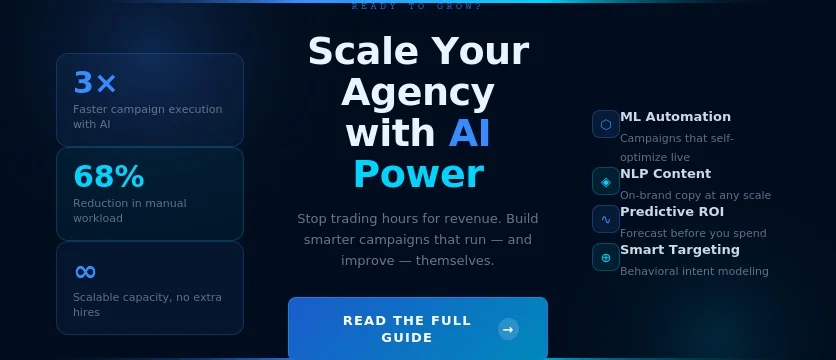
The intersection of human creativity and machine intelligence marks a significant basic shift in how Digital Marketing agencies operate. It is no longer an argument of replacement, but rather an advancement of parts, where competitive survival depends on building an integrated ecosystem.