










Key Takeaways
- Google AI Overviews vs traditional search represents a shift from ranked links to AI-generated answers at the top of the page
- Click-through rates are changing — but being cited inside AI Overviews delivers strong brand visibility
- GEO vs SEO is not a replacement debate — agencies need both working together as a combined AI visibility strategy
- Content structure, EEAT signals, entity recognition, and answer blocks are the new levers for AI Overviews SEO
- Agencies that adapt their services to include AI search marketing and GEO strategy will protect client results and add new revenue streams
- The agencies winning in 2026 are treating Google AI Overviews as an opportunity to earn more visibility — not just a threat to existing rankings
Google AI Overviews vs Traditional Search: What Agencies Need to Know
Something changed at the top of Google’s search results – and it’s quietly reshaping how your clients get found online.
Millions of search queries now feature Google AI Overviews at the top of the page, above ads and featured snippets. Users receive an answer generated by AI before they see any website link. Some don’t scroll further at all.
For marketing agencies, Google AI Overviews vs traditional search is no longer a theoretical debate. It’s a practical challenge affecting client traffic, visibility, and the value of the SEO services you deliver right now.
TL;DR:
Google AI Overviews vs traditional search represents a fundamental shift in how Google delivers answers. Agencies that understand the difference — and adapt their strategies — will protect client results and open new service opportunities in 2026.
What Is the Real Difference Between Google AI Overviews and Traditional Search?
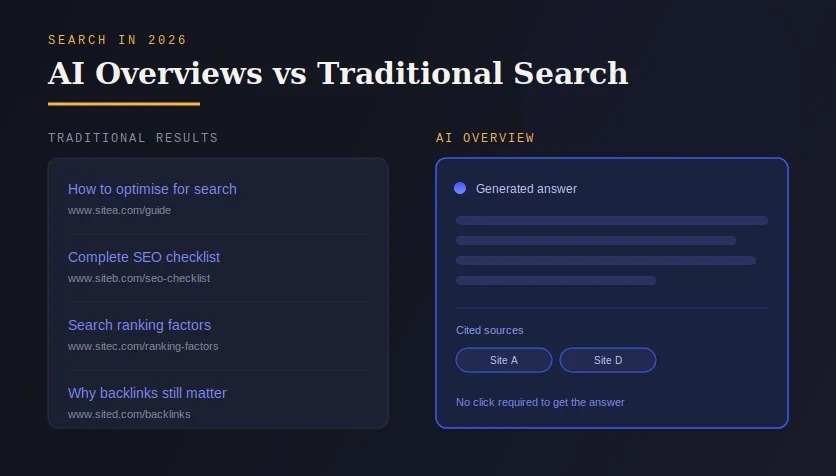
Traditional search shows users a list of ranked website links. Google AI Overviews generates a direct answer at the top of the page — pulling from multiple sources and summarizing them without requiring the user to click through.
In traditional search, ranking on page one meant your client’s website got seen. Position one got the most clicks. The entire SEO game was about climbing that list.
Google AI Overviews vs traditional search flips that model. Now, even a page one ranking may sit below an AI-generated summary that answers the user’s question completely. The user reads the answer, gets what they need, and leaves – without visiting any website.
This is the core of what search evolution looks like in 2026. It’s not that Google rankings don’t matter anymore — they absolutely do, because AI Overviews draw from trusted, well-ranked sources. But being ranked is no longer enough on its own. Your client’s content also needs to be the kind of content AI Overviews will pull from and cite.
How Do Google AI Overviews Affect Client SEO Results?
Google AI Overviews are reducing organic click-through rates for many query types – while simultaneously giving massive visibility to the sources they cite directly in generated answers.
Here’s what agencies are seeing in practice:
- Informational queries that used to drive strong organic traffic are now partially or fully answered by AI Overviews
- Click-through rates on some keywords have dropped as users get answers without clicking
- Clients whose content is cited inside AI Overviews are seeing brand visibility increase — even when clicks don’t follow every impression
- Clients with thin, keyword-stuffed, or poorly structured content are being skipped by AI entirely
The agencies that are navigating this well are the ones who have already started thinking about AI Overviews SEO — not as a replacement for traditional SEO, but as an additional layer that requires different content and structure decisions.
As we covered in our complete guide on SEO for ChatGPT and AI Search, the goal has shifted from ranking to being cited. Those are related but different objectives — and they need different strategies.
What Is GEO vs SEO and Why Does the Difference Matter for Agencies?
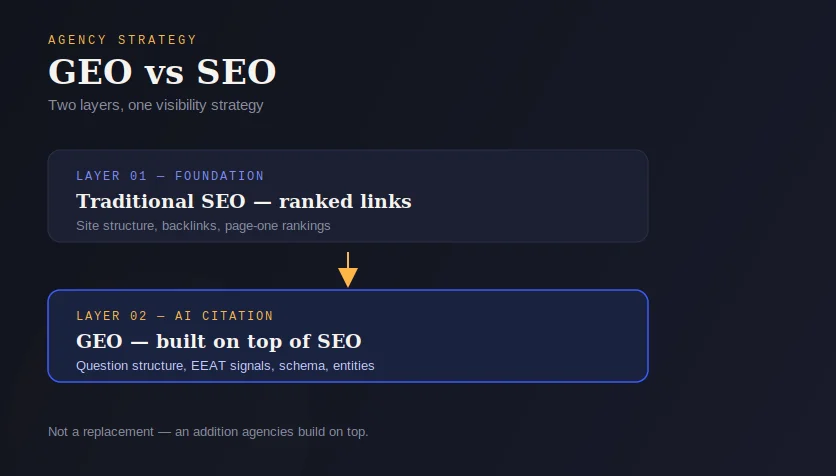
GEO (Generative Engine Optimization) is the practice of optimising content to be cited by AI-generated answers — while traditional SEO focuses on ranking in link-based search results. In 2026, agencies need both.
Traditional SEO gets your client’s website in front of users through ranked links. GEO vs SEO isn’t an either/or choice — it’s a layered strategy where SEO builds the foundation and GEO builds the AI citation layer on top of it.
For agencies, this means adding new elements to existing client work:
- Question-based content structure — headings framed as questions with direct answers AI can extract
- EEAT signals — author credentials, case studies, and reviews that prove expertise and trustworthiness
- Entity optimisation — schema markup, consistent business information, and third-party mentions that help AI recognize the client as a real, trusted entity
- Answer blocks — short, clear paragraphs after each heading that summarise the answer before expanding
We broke down how entity signals specifically drive Google AI search citations in our article on Entity SEO and AI Search Rankings — worth sharing with clients who want to understand why these changes matter.
The practical application of AI search marketing for agencies means auditing existing client content against these new criteria — and identifying which pages have the highest potential to earn AI Overview citations with targeted improvements.
For agencies that have already started offering structured AI audits, our guide on How to Offer AI Visibility Audits as a New Agency Service covers exactly how to package and deliver that assessment as a paid service.
Read More : How to Offer AI Visibility Audits as an Agency Service
FAQs About Google AI Overviews vs Traditional Search
Q: Should agencies stop focusing on traditional Google rankings now that AI Overviews exist? No. Traditional rankings still drive significant traffic — especially for commercial and transactional queries where AI Overviews appear less frequently. The right approach is a two-surface AI visibility strategy: optimise for traditional rankings and for AI Overview citations simultaneously.
Q: How do agencies get client content cited in Google AI Overviews? The content is clear, well-structured, and authoritative. * Headings based on questions, with the answers right there. * Create FAQ sections. * Implement schema markup. * Establish EEAT signals. * Earn mentions in trusted third-party sources. AI Overviews pull from content that answers questions completely and comes from sources Google trusts.Intent that answers questions completely and comes from sources Google trusts.
Q: Are Google AI Overviews hurting all clients equally? No. Clients with informational, how-to, and research-oriented content see the most direct traffic impact. Clients in local services, transactional categories, and high-intent queries often see less disruption — and sometimes benefit from being cited in AI Overviews for their area.
Q: How should agencies explain Google AI Overviews to clients who don’t understand the shift? Keep it simple: “Google is now answering some questions directly on the page. We need your content to be the source Google uses for those answers — not just a link below them.”
Ready to help your clients win in both traditional search and Google AI Overviews?
At Nice Digitals, we help marketing agencies deliver white-label GEO strategy, AI visibility audits, and content optimisation that works across every surface of search in 2026 — under your brand, with results your clients will see.
👉 Talk to our team today and let’s build your agency’s AI search strategy together.