










Key Takeaways
- Entity SEO helps AI tools recognize and recommend your business by name
- Knowledge graph SEO and semantic SEO work together to build AI visibility
- Schema markup, consistent NAP data, and third-party mentions are your core tools
- Topical depth through content tells AI what your business knows and does
- Entity optimization is the foundation — everything else in your AI SEO strategy builds on top of it
Want AI to start recommending your business? At Nice Digitals, we build entity-optimized, AI-ready digital presences for law firms, HVAC companies, and the agencies that serve them. From schema implementation to full GEO optimization services — we handle the technical details so you can focus on your clients.
Entity SEO: The Foundation of AI Search Rankings in 2026
The central principle of entity SEO is the idea that in 2016, it will be the most crucial concept that every business owner and marketing agency should grasp.
TL;DR: Entity SEO is one that ensures Google knows to show up your business, what it does, and how it will affect them. If not, even powerful content can get lost among the sea of blogs because it’s not targeting the right keywords.
The question is, what is Entity SEO and why is it important for AI search rankings?
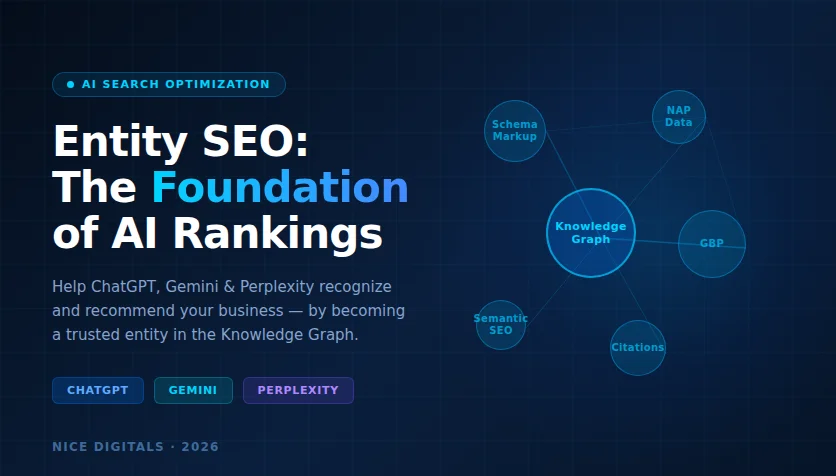
In the SEO world an ‘entity’ is something that can be described and is plainly a person, a business, a location, a product or a concept. Google has millions of such entities and links them together in its Knowledge Graph.
But when a user queries ChatGPT, “Who is the best personal injury lawyer in Chicago?” — AI does not search for keywords. It looks for entities it already knows and trusts. If your law firm is a recognized entity in Google’s Knowledge Graph, your chances of being cited jump significantly.
This is why entity-based SEO has moved from a technical concept to a business necessity
How Does the Knowledge Graph Connect to AI Visibility?
Google’s Knowledge graph is a huge database of facts, or facts about facts – Entities and relations among entities. AI tools like Gemini and Google AI Overviews pull directly from it when generating answers.
Think of it as AI’s contact list. If your business is on that list — with accurate details, clear connections, and trusted mentions — AI can confidently recommend you. If you’re not in it, you’re essentially a stranger.
Knowledge graph SEO means taking deliberate steps to get your business registered and well-described within that system. This includes:
- A complete, verified Google Business Profile
- Standard Name, Address, Phone (NAP) information throughout all directories
- Wikipedia or Wikidata entries for established brands
- Structured data markup (Schema) that describes your business clearly
- Mentions on authoritative third-party websites
We covered how these same signals power SEO for ChatGPT and AI Search in our previous guide — entity recognition is the engine underneath all of it.
So, what is semantic SEO and how does it help with entity optimization?
Semantic SEO involves building content on a given topic that goes deep and links related concepts together, meaning that AI will be able to capture the context of your business and not just individual keywords.
Entity optimization and semantic SEO work hand in hand. While entity SEO establishes who you are, semantic SEO tells AI what you know.
For example, an HVAC company that only has a homepage and a contact page looks thin to AI. But an HVAC company with detailed guides on “AC maintenance,” “furnace repair,” “indoor air quality,” and “seasonal HVAC tips” looks like a true subject matter expert.
That depth of content is what builds topical authority — and topical authority is a major factor in Generative Engine Optimization (GEO), which we’ve explained in detail for businesses looking to dominate AI search results.
How to Do Entity Optimization: Step-by-Step
Entity optimization involves doing everything possible to make your company easy to recognize, verify, and trust in lots of data sources.
Follow these steps:
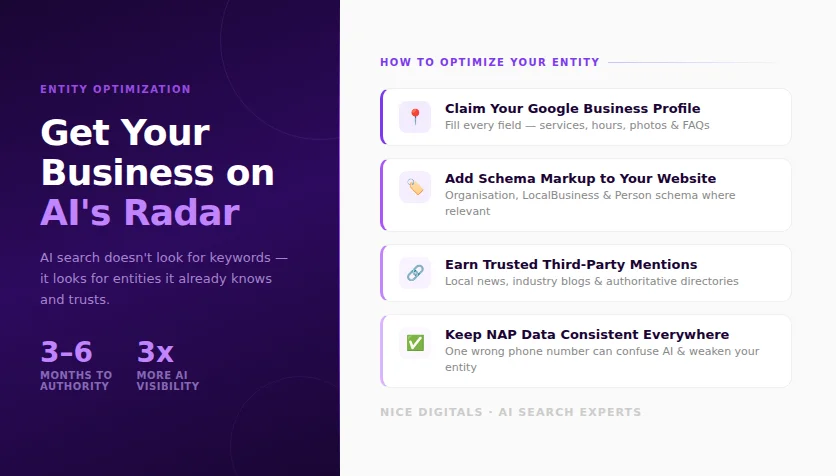
- Finish and Claim a Google Business Profile — Make sure to Fill Each Space: Services, Hours, Photos, FAQs
- Include Schema markup on the website — Apply Organisation Schema, LocalBusiness Schema, and Person Schema when applicable
- Get listed in authoritative directories — Yelp, BBB, legal directories, industry associations
- Earn mentions from trusted sources — Local news, industry blogs, and partner websites all signal to AI that your entity is real
- Keep your information consistent everywhere — One wrong phone number across directories can confuse AI and weaken your entity profile
- Link your social profiles to your website — LinkedIn, Facebook, and Twitter all contribute to your entity footprint
Read More : AI Search Ranking Factors: What We Know So Far
FAQs About Entity SEO and AI Search
Q: What is the difference between entity SEO and keyword SEO? Keyword SEO focuses on matching search terms. Entity SEO focuses on making AI understand what your business actually is. In 2026, you need both — but entity SEO is what gets you cited in AI-generated answers.
Q: Does entity SEO help with ChatGPT and Perplexity rankings? Yes. Both ChatGPT and Perplexity reference entities they recognize from trusted data sources. A well-established entity profile increases your chances of being named directly in AI responses.
Q: How long does it take to build entity authority? Most businesses see meaningful improvement within 3–6 months of consistent effort — especially after completing their Google Business Profile, adding schema markup, and earning third-party mentions.
Q: Is entity SEO only for big brands? Not at all. Google Business Profile, local citations and a couple of quality third-party mentions can result in a credible entity profile for small and local businesses. AI isn’t just referencing “big brands”, it’s referencing those brands that one can trust.
👉 Get in touch with our team and let’s put your business on AI’s radar.