










AI Search Ranking Factors: What We Know So Far
Nobody handed out a rulebook when AI search took over.
Google has its 200+ ranking factors. ChatGPT, Gemini, and Perplexity? They don’t publish anything. But after months of testing, observation, and real client results, patterns are emerging. And those patterns tell us a lot about what actually moves the needle.
This post breaks down the AI search ranking factors we know matter right now — and what your business can do to work with them.
If you’re newer to this space, our guide on what AI search optimization is and why it matters in 2026 gives you the full foundation before diving into specifics.
GEO Ranking Factors: What Generative Engines Actually Look For
Generative Engine Optimization (GEO) is the practice of making your content worthy of being cited by AI tools. The GEO ranking factors aren’t about keyword density or meta tags. They’re about trust, clarity, and real-world authority.
Here’s what we know matters:
- Content that directly answers questions. AI tools are built to answer questions. If your page dances around the point, it won’t get cited. Pages that open with a clear, direct answer — then back it up — consistently perform better in AI-generated responses.
- Topical depth, not just keywords.ChatGPT and Gemini tend to favor websites that explore a topic in depth. A single well-written pillar page with strong related content is better than ten short blog posts. That’s why creating topic clusters is more important than ever.
- Keywords are not the sole focus of Google’s ranking algorithm, since it appears that ChatGPT and Gemini are fond of sites that go the extra mile on a topic. One well-written pillar page that has good supporting content is better than ten shallow blog posts by a mile. That is why you must build topic clusters.
AI SEO Signals: The Trust Factors That Move the Needle
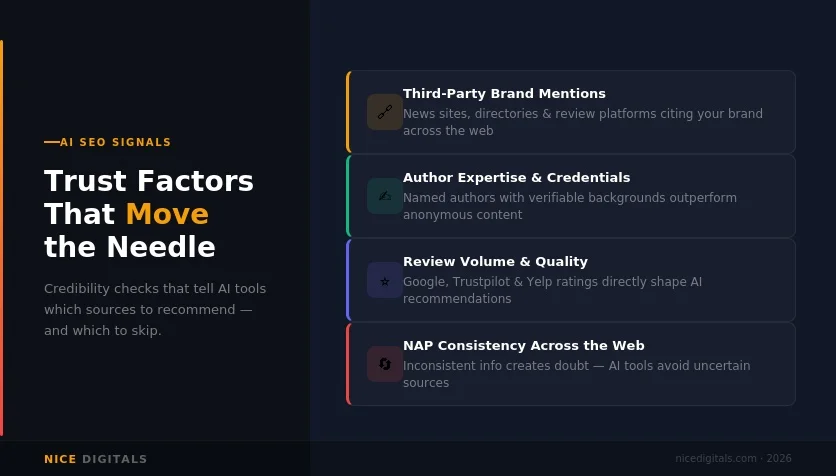
AI SEO signals are the behind-the-scenes markers that tell AI tools a source is worth recommending. Think of them as credibility checks.
The strongest ones we’ve identified:
- Third-party brand mentions — Is your business talked about on other credible websites? News articles, industry directories, review platforms, and partner pages all count. The more external sources reference your brand, the more AI tools trust it.
- Author expertise — Pages with named authors who have clear credentials perform better. This doesn’t pass for knowledge, stating on a bio that they have been in the digital marketing field for 10 years and worked with 200+ brands speaks for their expertise. Anonymous content rarely gets cited.
- Review volume and quality — Google reviews, Trustpilot, and Yelp ratings directly influence how AI tools like Gemini describe and recommend local businesses. A business with 200 four-star reviews is going to beat one with 15.
- Uniformity throughout the Internet — It is imperative that this information be the same on all platforms. AI tools do not use sources of doubt, and inconsistency engenders doubt. Inconsistency creates doubt, and AI tools avoid uncertain sources.
For agencies managing multiple clients, running a proper AI visibility audit is the fastest way to spot which of these signals is weak.
Exploring the enigma behind ChatGPT Rankings: The algorithm of OpenAI that chooses who to introduce to you.
ChatGPT rankings don’t work like Google’s. There’s no page-one position. Instead, ChatGPT forms an answer by pulling from what it knows about a brand and what it finds credible across the web.
- What influences it most:
- Training data and public information — ChatGPT’s base knowledge comes from what was publicly available before its last training cutoff. Brands with strong online presence, media coverage, and published content before that cutoff have a head start.
- Browsing mode citations — When ChatGPT browses the web, it picks sources that are authoritative, well-structured, and directly relevant. Getting featured in industry roundups and “best of” lists helps significantly.
- Wikipedia and knowledge graph presence — For established brands, having a Wikipedia page or appearing in Google’s Knowledge Graph tells AI tools you’re a verified, recognized entity.
We covered the specific steps for getting recommended by ChatGPT in our guide on how to optimize a website for ChatGPT, Gemini, and Perplexity.
AI Visibility Signals: The Technical Side You Can’t Ignore
Even the best content fails if the technical foundation is broken. These AI visibility signals are often overlooked but consistently matter:
- Page speed under 3 seconds
- Mobile-responsive design
- Schema markup – especially FAQ, Article, and LocalBusiness types
- Clean site architecture with logical internal linking
- An updated sitemap that search engines can actually crawl
Schema markup deserves special attention. It does more than just benefit Google – it benefits all AI tools that consume structured data to better understand your page, who authored it, and its worthiness of trust.
Also Read : How to Optimize a Website for ChatGPT, Gemini & Perplexity for AI Search Visibility in 2026
FAQ: What is an AI Search Algorithm and how does it work?
Q: Do AI search algorithms use the same signals as Google?
There is some overlap there – technical health and content quality count on both, as does authority. However, AI tools have other factors they consider that Google excludes, such as brand mentions on social platforms and web content that’s not technically searchable.
Q: Can a new website rank in AI search results?
Yes, a new website can be indexed in an AI search. Building external links, gaining reviews, and providing regular expert material will make it difficult for AI tools to reference them. Do simple things such as directory listings and review generation first.
Q: Does social media activity affect AI search visibility?
Indirectly, yes. A strong social presence leads to more brand mentions, more traffic, and more third-party content about your brand — all of which contribute to the trust signals that AI tools look for.
Q: Are AI search ranking factors the same across ChatGPT, Gemini, and Perplexity?
The core factors overlap — trust, content quality, and authority — but each platform weighs them differently. Gemini leans heavily on Google’s existing signals. Perplexity favors fresh, well-cited content. ChatGPT weights brand recognition and training data heavily.
What This All Means for Your Strategy Right Now
AI search isn’t a separate channel anymore. It’s the channel where buying decisions start.
The businesses showing up in ChatGPT answers, Gemini overviews, and Perplexity citations in 2026 aren’t there by accident. They built authority, published expert content, earned external mentions, and kept their technical foundations clean.
The AI search algorithms are still evolving. But the fundamentals are clear enough to act on today.
At Nice Digitals, we help agencies and businesses build the kind of AI search presence that compounds over time. From content strategy to technical audits, our white label SEO services give your clients the visibility they need — across both traditional and AI search. Let’s talk about where to start.