









Key Takeaways:
- Create genuinely helpful, in-depth content that directly answers user questions with clear, accurate information.
- Demonstrate Experience, Expertise, Authoritativeness, and Trustworthiness (E-E-A-T) through expert insights, author bios, and credible references.
- Use structured data (Schema markup) to help AI systems better understand your content and entities.
- Build topical authority by publishing comprehensive content clusters around your niche instead of isolated articles.
Back then, ranking on the first page of Google was a pretty sure thing. Not anymore. Recent industry data shows the overlap between top Google results and AI-cited sources has dropped sharply over the past year, meaning a whole new set of AI search ranking factors now decides who gets mentioned in ChatGPT, Gemini, and Perplexity answers — and who doesn’t.
Why Traditional Rankings No Longer Predict AI Citations
Some brands with strong Google rankings are essentially invisible in AI answers, while pages with little organic visibility get cited regularly. Research from multiple GEO firms has found a meaningful share of ChatGPT’s most-cited pages don’t rank in Google’s top 10 for the same query at all. This gap is the core reason understanding AI search ranking factors separately from SEO now matters.
Entity Recognition: The Foundation of AI Visibility
AI systems don’t just match keywords — they map entities: your brand, products, people, and how they relate to other known concepts. Strong ChatGPT ranking factors start with entity clarity:
- Consistent brand and product naming across your site and third-party mentions
- Clear “who, what, why” information on About and service pages
- Structured data that explicitly defines entities (organization, person, product schema)
This is the same foundation covered in our Entity SEO post — building it well feeds directly into how AI models identify and trust your brand.
Citation Source Weighting
Not all sources carry equal weight with AI models. Generative engines tend to favor:
- Earned media — a significant share of AI citations come from third-party coverage, not owned content
- Original research and data — statistics with sourced links get cited more than opinion pieces
- Established publications and directories — sites with strong existing trust signals
- Recently updated content — freshness increasingly influences which sources get selected
Brands relying solely on their own blog, with no third-party mentions, are missing a major lever in AI search ranking factors.
Topical Authority Signals
AI systems evaluate depth across a topic, not just a single page’s relevance. What signals topical authority:
- Multiple interconnected pages covering related sub-questions
- Internal linking that builds a clear topic cluster
- Content that answers the “fan-out” sub-queries AI models generate when breaking down a complex question
If someone asks an AI “what’s the best CRM for a small SaaS team,” the model may search several related sub-queries separately. Sites covering only the broad topic, without addressing these narrower questions, get passed over.
Structured Data Types AI Actually Reads
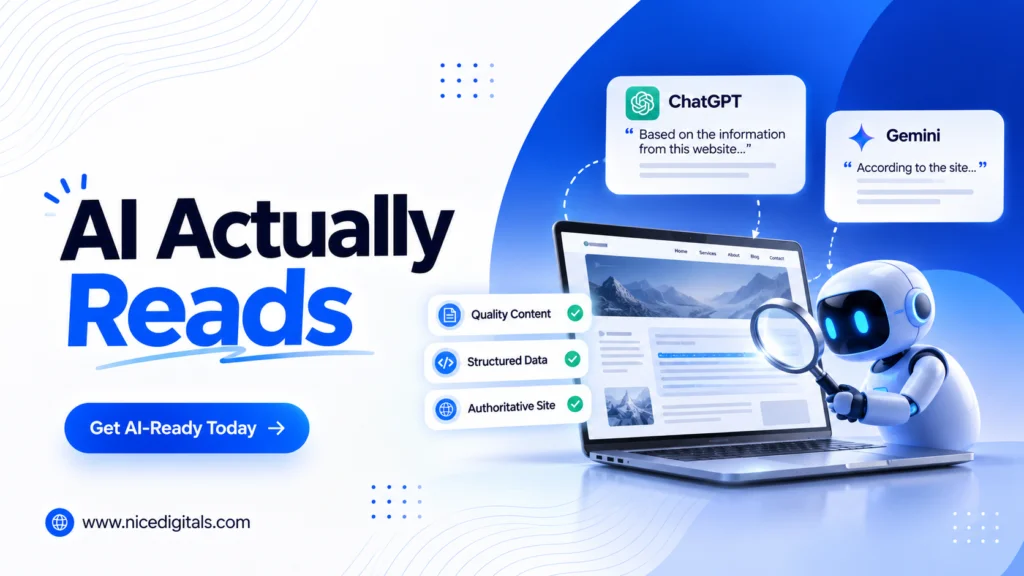
Structured data still matters, though not as a magic trigger. What consistently helps:
- Organization and LocalBusiness schema for entity clarity
- FAQ schema for direct question-answer content
- Article and Product schema for content and eCommerce pages
Google has been explicit that no special file or markup — like llms.txt — earns preferential AI treatment. Standard, well-implemented schema remains the reliable path, not workarounds.
Brand Mention Velocity
How often and how consistently your brand gets mentioned across the web — reviews, forums, press coverage, directories — is emerging as one of the more important GEO ranking factors. AI models weigh brand authority partly through mention frequency and consistency, similar to how backlinks functioned for traditional SEO, but broader in source type.
Wikipedia and Knowledge Graph Presence
Entities with a clear knowledge graph presence — Wikipedia, Wikidata, structured business listings — tend to be treated as more authoritative sources by AI models. This is not to say that each business should have a Wikipedia page, but the more consistent and accurate a business is across knowledge bases and directories, the more it will appeal to AI as a viable business to recommend.
FAQs for AI Search Ranking Factors
Which are the most essential AI search ranking factors for 2026?
Clear definitions of entities, variety of citations by third parties, freshness of content, and the implementation of structured data are more important than keywords.
Are there any distinctions between ChatGPT ranking factors and Google ranking factors?
Yes. While ChatGPT and other models place greater emphasis on earned media mentions, topical depth, and entity recognition over backlink quantity and keyword presence, this is not to say they do not care about the latter. However, the emphasis on earned media mentions, topical depth, and entity recognition indicates that ChatGPT and other models place more importance on these factors than on backlink volume or keyword density.
Why is AI recommending a business to a potential client over another company?
Brands that appear on reputable third-party sites often trigger recommendations by AI, and a well-structured site with good topical authority does the rest.
Final Thoughts
AI search ranking factors reward authority, clarity, and consistency across the web — not just on-site optimization. For a broader strategy on building this visibility, see our GEO explainer and SEO for ChatGPT posts, and use our AI Visibility Audit post to check where your brand currently stands.