










Key Takeaways:
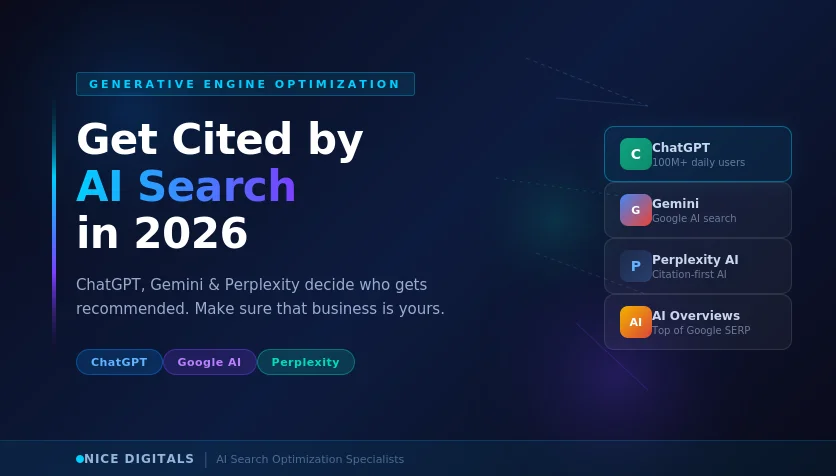
AI search solutions, such as ChatGPT, Google AI Overviews, Gemini and Perplexity, have become a cornerstone of how users are discovering organizations. Businesses can use AI search solutions like ChatGPT, Google AI Overviews, Gemini and Perplexity as a major channel for users to discover them.
- It’s not just about ranking your content for ChatGPT and AI Search – it’s about getting them cited.
- The building blocks of Generative Engine Optimization (GEO) are clear answers, EEAT signals, structured data, and topical depth.
- The components of a good AI SEO strategy include headings in the form of questions, answer blocks, schema markup, and third-party mentions.
- With old SEO it was all about getting good rankings and keywords. New SEO – answers, authority and AI citations
- The companies that are going to win in 2026 are not doing anything special, they’re just being practical and proving to be helpful.
You are losing out orders you didn’t even know you had if you don’t appear in AI search results
People don’t just Google things any more in 2026. They ask ChatGPT. They use Perplexity. They receive information directly from Google’s AI Overviews without ever clicking any websites. So who are the businesses that appear in those answers? They’re winning.
TL;DR: SEO for ChatGPT and AI Search involves optimizing your content to be trusted, able to be read, and cited by these AI-powered platforms. It is called “Generative Engine Optimization” (GEO) and it is probably the most significant change in digital marketing since Google’s inception. This guide will teach you how to do it!
What Is SEO for ChatGPT and AI Search?
The process of optimizing your content for ChatGPT and AI Search is SEO for ChatGPT and AI Search.
For years traditional SEO was all about ranking your site on page one of Google. This isn’t the case with AI search optimization. Whereas AI tools provide a single direct answer, links are provided to lists of information across the web to be read. With clear, credible, and authoritative content, you are the source that AI relies on.
If you’ve thought of it, this way is the equivalent of old SEO getting you on the shelf! When you are at the checkout counter, you will find the recommendation thanks to AI SEO.
This is also referred to as Generative Engine Optimization (GEO), “making content AI-citation ready. But in 2026, it’s not an option anymore.Who needs this? Any business who desires to exist online. If your customers are utilizing the internet to find answers, you require the aid of an AI SEO strategy that enables you to do just that.Whether you are handling law firms, HVAC, e-commerce or any other service, you cannot help but needing the support of an AI SEO technique to do just that.
How Does AI Search Actually Work?
The AI search tools (ChatGPT, Gemini and Perplexity) perform web searches, filter relevant, news-led and reputable information, and can provide a response to the user without requiring them to visit a site.
It works in this way; here’s the breakdown:
- The user types or speaks a question to an AI tool.User inputs a query or asks a question via an AI tool.
- This is by using the AI to search through billions of web pages (or training data).
- Seeks material that is coherent, factual, authoritative, and well-structured
- World Literature focuses on pulling a study’s best answer, and then either quoting or paraphrasing/citing the source.
- The user can receive the desired response in seconds – often without even leaving the AI platform.
The major difference compared to Google: google will return a list of results to you. AI search selects a single answer. Competition is tougher, but if selected, the prize is great – or for my accepted boldness of saying it – too good to be resisted.
Question from real users: What is the average timeframe for AC unit servicing for a typical homeowner in Phoenix?Sample question: If a resident of Phoenix asks ChatGPT, “how often should I get my AC serviced? ChatGPT will mention your business by name if the HVAC company mentioned it in their clearly crafted article answering that question.Your HVAC company would be better off having a well written clear article that answers that question, and ChatGPT will reference your business by name if it does. That is truly the magic of free high trust visibility, no ad spend throwaway.
What Are the Main AI Search Platforms in 2026?
Then are the four giant AI hunt engine to watch out for in 2026 ChatGPT, Google AI Overviews, Google Gemini, and confusion.
So, let’s first snappily look at them one by one
Over 100 million users around the world enjoy ChatGPT (OpenAI) every day as a way to find out information about their businesses. It is now active and pulls in web pages most of the functionality of Internet Browsing was later added. ChatGPT can dynamically read authoritative crawlable websites.
This is well positioned at the top of the SERP, ahead of any organic results and any ads. It provides a summary of content from trusted resources. Getting quoted here is more impressive than “featured snippet” but isn’t as widely recognized.
Gemini (Google) Gemini is integrated into the Google Search, Android and Workspace apps. It’s the artificial intelligence assistant we use Unknowingly. It draws from Google’s knowledge graph, which means your Google Business Profile, site and reviews are all important.
Perplexity AI is rapidly gaining popularity among researchers and professionals. It has always been a principle of perplexity to reveal its sources; therefore, the citation is particularly valuable to build brand credibility.
The takeaway: Your content should be effective across all four. Perhaps the most important is that these strategies are effective across all platforms.
What Are the Key AI Search Ranking Factors?
Content creation tools powered by AI prioritize clarity, trustworthiness, factfulness, and formats based on actual queries.
Here are the top AI search ranking factors for 2026:
Correct Answers—Are answers possible directly out of your content in the first few lines of a section?
EEAT signals: Experience, Expertise, Authoritativeness and Trustworthiness. Real author bios & credentials, case studies, and reviews.
The topical tendencies — One excellent article is not enough. AI will reward sites that have extensively written about a topic on numerous pages.
Structured data / schema markup: It’s when you add style that is understood by AI: FAQ Schema, Article Schema, HowTo Schema make AI immediately read and categorise your content.
Brand mentions and citations – AI will see you as an factual, trusted reality if you get appertained to on third parties, original news, directories, and industry blogs.
Content formatting is important; it makes it easier for the AI to understand with conversational rudiments like question- grounded headlines, short paragraphs, pellets, and numbered way.
Information over to date and accurate–eschewal of out–of–date and inaccurate information is n’t heard. Content written using AI is well-versed in the latest trends and verified facts.
If the websites are not loaded quickly, they are not mobile friendly, and do not work, their technical health is still the base. Technical health is still the starting point — quick loading, mobile friendly, error-free websites.
How to Build an AI SEO Strategy Step by Step
Adopting the right combination of content production, technical configuration and credibility factors will ensure that your business will be referenced by AI tools on all of the main platforms.
The steps to follow:
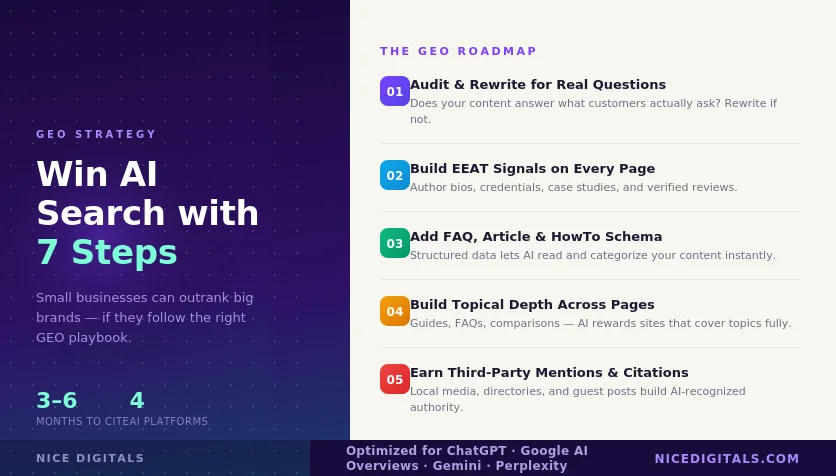
Step 1: Audit Your Own Website’s Content: Review existing website content. Ask if this is actually a real question my customer would ask? Is it clear and direct? Is it knowledgeable? If the answer is ‘no’ the content must be rewritten.
Step 2 — Integrate EEAT into All Pages Include author biographies that incorporate qualifications. Share true case studies, results. Gather and showcase Google reviews. Have your ‘About’ page convey why you’re qualified to them.Let your About page demonstrate your skillfulness. These signals act as indicators to AI that determine whether the content you produce is trustworthy or not.
Step 3. Rewrite Content in Terms of Questions Replace “Our Services” with a question, such as “What Services Does a Personal Injury Lawyer Provide?” Each of the major sections should contain a question and its answer.
Step 4—Apply FAQ Schema, Article schema and HowTo schema onto the appropriate pages. This is technical, but some of the most impactful things you can do to make AI more visible. This can be done within a few hours by a developer.
STEP 5 — Develop Topical Depth: Select the 3 most important areas of service. A first guide and accompanying FAQs, how-to articles, comparison posts, and case studies for each. This will help establish topical expertise in AI’s eyes.
Step 6 — Earn Third Party Mentions: Contact local media. Be included in business directories. Do guest blog posts for appropriate blogs. The more often your business name is featured on reputable, legitimate outside platforms, the more likely AI is to recognize you as a legitimate, real business.
Step 7 — Artificial Intelligence search is constantly changing its form and features. Agree to regularly audit and update your best content every 3 – 6 months. Include new information, replace examples and delete outmoded material.
What Are Common Mistakes Businesses Make With AI Search?
Too many companies do not even consider AI search or they attempt to use legacy SEO methods on a vastly different platform in no way suited for the new technology, with both strategies failing.
Here are the more often than not blunders you will need absolutely to stay clear of:
Keying in for keywords, rather than answers. AI doesn’t mind about the number of times you’ve utilized a phrase. Does it ask, and does it answer the question?
No EEAT signals. An anonymous, unsourced, and unsprofiled piece of content is not read by the AI tools.
Thin content. It is not possible to cite a 300 word page with/include a vague information. AI requires complexity, clarity, and structure.
Ignoring schema markup. Structured data is like speaking to AI in the universally understood language. To miss competer is to lose a big disadvantage.
Only thinking of Google. ChatGPT and Perplexity are on the rise. A digital strategy solely for executing against Google is incomplete as of 2026.
One-and-done content. You can only have one version of this content out there; if it’s not updated, then AI will believe that it may be outdated. Frequent updates demonstrate that your website is updated and relevant.
What Are Advanced Tips for GEO Optimization Services?
If you’re looking for more advanced GEO optimization techniques, these can take your business from “sometimes cited” to “consistently recommended” by AI.
Tackle Vague Writing with Semantic Clarity AI can’t read shoddy writing. For “We offer great services for your needs,” use the term “We provide personal injury legal representation for car accident victims in Texas. Be specific. Be factual. Be clear.
Write 2-3 answer sentences before entering into detail, making it as easy as possible for AI to understand the content – this is called “AI-Friendly” Answer Blocks. This will provide AI with a pre-made extract to pull into a response.
Develop a Good Internal Linkage Connect related articles. Link inclusive of two guides: HVAC maintenance tips and how to choose an AC unit. This enables AI to comprehend everything about a subject.
In 2026, the value of a Digital PR campaign is higher than having hundreds of spammy backlinks. A mention on a trusted publication can be a great encouragement toward getting your AI cited.
Track AI Mentions Be sure to see if your business is mentioned by AI tools. Use ChatGPT and other AI tools, like Perplexity, to look up your services. When others are coming and you’re not, you know what you have to do.
Frequently Asked Questions About AI Search Optimization
Q: What is the difference between SEO and GEO?
A: SEO is search engine optimization whereas GEO is geotargeting. Traditional SEO assists your website get displayed on search engine results pages. GEO (Generative Engine Optimization): This involves earning the content’s citations or references directly within the AI-generated answers. You see your name on the list with SEO. GEO delivers the recommendation.
Q: How long does it take to rank in AI search results?
A: You should expect to appear in search results from AI within five minutes.Generally, you can expect the results from Google AI to appear in five minutes. The exact period of time varies, but AI citations can begin appearing in a business’s web pages within 3-6 months of regular, quality, and organized content creation. Creating EEAT Signals and receiving third-party mentions can help expedite this process.
Q: Do you need to redesign your site for AI search?
Not necessarily. Many of the time, you can edit your current content and introduce schema markup, plus put things in a new organization without completely redesigning. But if your website is slow, outdated and confusing to navigate, a rebuild will do a lot to improve.
Q: Does Google AI Overviews hurt my website traffic?
A: No, it won’t harm your website traffic.No, Google AI Overviews is not going to affect your website’s traffic. Can decrease some click-through rate because of giving answers without users clicking on it. As Google’s AI depends on this source for information, the brand credibility and trust are tremendous. While the raw business numbers might change, numerous businesses are discovering that AI citations not only induce more business but also deliver better leads and better SEO results.
Q: Is AI SEO strategy different for local businesses?
Yes. Original businesses need to combine GEO stylish practices with strong original signals — a well- maintained Google Business Profile, harmonious NAP( Name, Address, Phone) data across directories, and original reviews.
Google’s local data play an important part in giving location-specific answers with AI.
Q: Can small businesses compete in AI search against big brands?
Absolutely. The essence of AI search: Clear content, expertise, and trustworthiness, not just domain authority or high ad spend. A small business’s article that is written well and is EEAT can beat a large corporation’s generic article by optimizing their website content to rank higher.By optimizing their website content to rank higher, a small business can outperform a large corporation’s generic article, especially if that article is well written and EEAT compliant.
What Geckbo Collection Is Pointing to is concluding: The Future of Search is Here.
Premix the ingredients together.
Also Read : White Label Google Ads Services for Faster Agency Growth
The conclusion: If you’re looking to make your business find-able for the AI in ChatGPT, Gemini, or Perplexity when they ask for guidance, it requires content that the AI can believe. That involves writing for people, structuring content for search engines, and developing content that’s credibility that can be detected by both humans and machines.
This change is occurring in real time. Then comes the question; are your business on the right side of it?
Looking to Step Up Your Business Game and appear in AI search results? At Nice Digitals, we assist marketing agencies and their clients in developing strategies that deliver content and technical solutions that can perform on Google and AI platforms. We handle the complexities of AI search optimization services, white-label SEO and GEO strategy, so that you don’t.
Contact our staff now and we will all create a search presence with AI in 2026!