










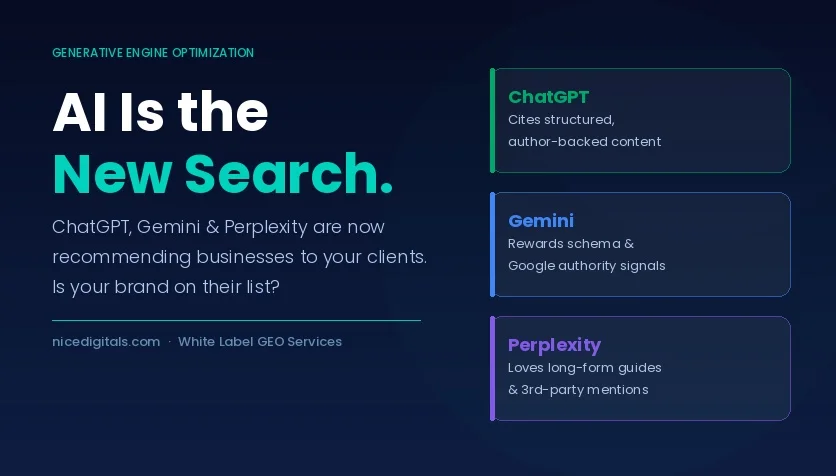
How to Optimize a Website for ChatGPT, Gemini, and Perplexity
Here’s what’s going on now. A prospective client opens up ChatGPT and types out, “Who is the best digital marketing agency near me?” ChatGPT gives them three names. Your client isn’t one of them.
The Question is How to Appear in AI Search Visibility in 2026?
That’s the new SEO problem in 2026. And it’s not solved by chasing Google rankings alone.
To optimize a website for ChatGPT, Gemini, and Perplexity, you need a different playbook. These AI tools don’t just crawl pages — they decide which businesses are worth recommending. This guide breaks down exactly how to get on that list.
If you’re still getting your head around why this matters, start with our breakdown of what AI search optimization is and why it matters in 2026. Then come back here for the how.
What Is GEO Strategy and Why Does It Replace Old SEO Thinking?
GEO stands for Generative Engine Optimization. It’s the practice of making your content easy for AI engines to find, read, trust, and recommend.
Old SEO was about ranking. GEO is about being cited.
When someone asks Gemini or Perplexity a question, the AI pulls from sources it finds credible and well-structured. It doesn’t rank pages – it picks the ones that best answer the question with authority. Your GEO strategy has to make your site that obvious choice.
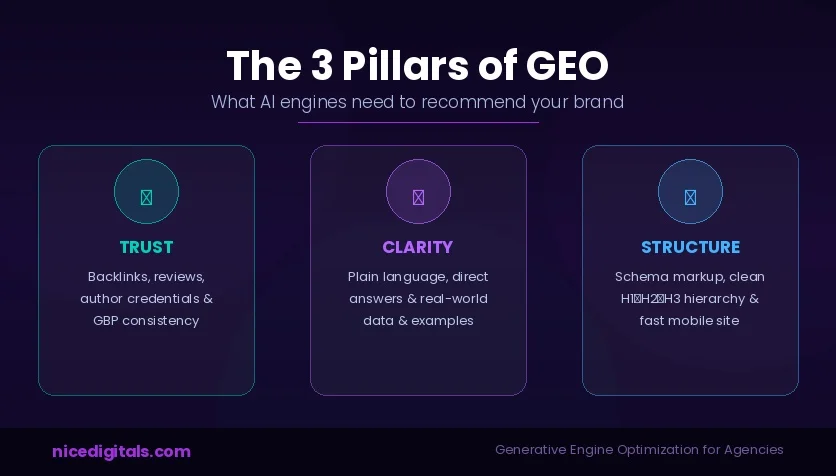
The three pillars of GEO are:
- Trust – Does the web treat your brand as credible?
- Clarity – Does your content directly answer real questions?
- Structure – Can AI crawlers read and understand your pages easily?
Everything in this guide connects back to these three pillars.
How to Build AI Search Visibility Through Content That Gets Cited
AI applications use content as if it were actual expert language instead of content generated by a machine. Thin content, bland pages, or pages stuffed with “buzzwords” won’t be included.
Here’s what works for AI search visibility:
Write in plain, direct language. Grade 6 English wins here. Short sentences. Clear answers. Once you have a 12-year-old being able to understand your service page, an AI engine can summarize it quite easily.
Answer the actual question up front. Don’t bury the key point. If someone asks what you do, answer it in the first two lines. AI tools often pull the opening paragraph when forming a response.
Apply real-life situations and data. There’s a difference between citing a page that states we generated 47% more leads in 90 days and a page that states we deliver results. The page that promises to increase a client’s leads by 47% in 90 days is much more likely to be cited than the page that promises that we deliver results.
Add author bios with credentials. ChatGPT and Gemini factor in EEAT – Experience, Expertise, Authoritativeness, Trustworthiness. A named author with a real background signals credibility.
For content teams, our full SEO for ChatGPT and AI search guide covers content structure in even more depth.
Gemini SEO: What Google’s AI Needs to Recommend Your Site
Gemini SEO is closely tied to Google’s existing trust signals – but with a twist. Google Gemini now powers AI Overviews, which appear above traditional search results. When someone does not appear on those pages, they lose out on clicks before even reaching the scroll of their page!
To increase the chances of success with Gemini:
Implement schema markup: Schema markup like FAQ schema, HowTo schema, and Article schema guides Gemini to grasp your content architecture.
Earn backlinks from trusted sources – Gemini pulls from sites that Google already considers authoritative. A mention in a well-known publication matters more than ten low-quality links.
Keep your Google Business Profile updated – For local businesses, Gemini regularly pulls from GBP data when answering location-based queries.
Match search intent perfectly – If your page title says “best CRM for small businesses” but the content is a generic software list, Gemini will skip it.
If you’re helping local clients specifically, see how we approach local SEO in 2026 for agencies and businesses.
Perplexity Optimization: How to Get Cited in AI Answer Summaries
Perplexity is different from ChatGPT and Gemini. It works more like a research engine – it actively searches the web, picks sources, and cites them visibly in its answers. That makes Perplexity optimization one of the most actionable opportunities right now.
To get cited by Perplexity:
Get mentioned on third-party sites. Perplexity pulls heavily from external sources – review platforms, industry blogs, news sites, and directories. The more credible sites that mention your brand or link to your content, the more likely Perplexity is to include you.
Write long-form, research-style content. Perplexity loves content that seems like a well-informed article. Guides, comparisons, checklists, and how-tos work well. This very blog is the kind of content Perplexity tends to cite.
Use clear headings and sections. Perplexity scans headings to decide what a page is about. If your H2s are vague or missing, the AI can’t categorize your content correctly.
Keep your content current. Perplexity favors fresh information. Weak citations are blog posts with no updates from the past year, as compared to strong citations of well-kept guides from 2025/2026.
AI Recommendation Optimization: The Technical Side Agencies Miss
Getting your content right is only half the job. AI recommendation optimization also requires a solid technical foundation.
Run through this checklist:
- Site loads in under 3 seconds (slow sites get ignored)
- Mobile-friendly layout (AI tools factor in UX signals)
- Logical heading structure – H1 → H2 → H3
- Clean internal linking with descriptive anchor text
- Updated XML sitemap submitted to Google Search Console
- FAQ sections using structured markup on key pages
- Uniform Name, Address, Phone (NAP) in all directories
They don’t sound like dramatic fixes, but they impact the ability for AI engines to read, trust, and recommend your site. Before assuming the content is the problem, check the technical health first.
For agency teams managing this at scale, our white label SEO services handle both the content and technical side for your clients.
FAQ: Optimizing for AI Search Engines
Q: Does optimizing for ChatGPT hurt my Google rankings? No. The practices that help AI tools – clear content, schema markup, strong authority signals — also support Google SEO. They cooperate, NOT compete.
Q: How long does it take to show up in ChatGPT or Gemini answers? There’s no fixed timeline, but most businesses see changes within 60–90 days of consistent effort. Creating third-party mentions and posting consistently will help to accelerate the process.
Q: Do I need separate content strategies for each AI tool? Not entirely. The core principles – quality content, strong authority, clear structure — apply across all platforms. But small adjustments like using schema for Gemini or publishing long-form guides for Perplexity can give you an edge on each platform.
Q: Is AI search optimization only for big brands? Not at all. Smaller businesses with their particular experience and great reviews are most likely to appear more in references than large corporate brands. AI tools reward relevance and trust over size.
Read More : How to Improve Business Visibility in ChatGPT Search
Start Showing Up Where Your Customers Are Looking
Optimizing for ChatGPT, Gemini, and Perplexity isn’t a future strategy. It’s a right-now one. The businesses getting recommended today started building their AI search presence months ago.
The good news? Most of your competitors haven’t done this yet. That’s your window.
At Nice Digitals, we help agencies implement full AI search optimization strategies for their clients — from content audits to technical fixes to authority building. Talk to our team and let’s map out what it takes to get your clients showing up in the AI answers that matter.