


Key Takeaways
- What is generative engine optimization GEO comes down to optimizing content to be cited directly inside AI-generated answers, not just ranked in a list of links
- GEO vs SEO is a sequencing relationship — SEO gets content discovered, GEO gets it trusted and cited
- AEO and GEO overlap heavily, with AEO focused more narrowly on direct-answer formats
- GEO for agencies is a timely opportunity, since client demand is already outpacing most agencies’ current service offerings
- AI content optimization 2026 is becoming a standard expectation, not an experimental add-on
Can you give a one-sentence explanation of GEO if asked if you were in front of a client?
You already understand SEO. You know rankings, backlinks, and keywords inside and out. GEO is the next layer on top of that — and in 2026, it’s becoming just as important to your clients’ visibility as traditional search ever was.
This guide breaks down What is generative engine optimization GEO in plain terms, no unnecessary jargon, so you can explain it confidently to clients and start building it into your service offering.
TL;DR: Generative engine optimization (GEO) is the technique of optimizing content to get it written into the answers created by AI systems like ChatGPT, Gemini, and Perplexity, instead of being found in a list of links.
What Is Generative Engine Optimization (GEO) in Simple Terms?
Generative SEO involves optimizing your website to make it easy for AI engines to locate, understand, trust, and use it to generate a response to a user query.
Consider the following. Traditional SEO aims to get a website listed somewhere on the search results page, then noted by a human and opened. GEO helps content become the actual source an AI tool pulls from to answer a question directly — often without the user ever visiting a website.
The AI places just 10 links in its response when a customer asks “What’s the best CRM for a small real estate agency?” It selects 2 or 3 answers based on what it believes to be true. What is generative engine optimization GEO really comes down to: it’s the work that increases your odds of being one of those two or three answers.
This matters for agencies because clients are starting to notice traffic patterns changing, even when their Google rankings stay strong. GEO explains why — and gives you something concrete to offer in response.
GEO vs SEO: What’s Actually Different?
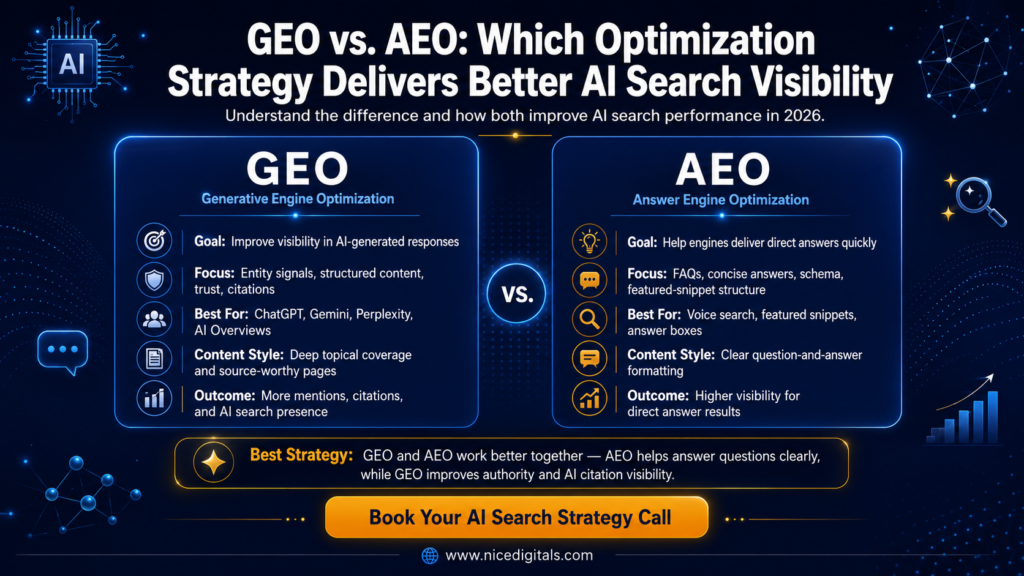
While GEO is more about being mentioned everywhere where generative AI is used, AEO zooms in specifically on optimizing content for direct-answer areas, such as featured snippets and voice search results.
The following is a comparison to think about:
- The emphasis of SEO is on keywords, backlinks, page speed, and ranking algorithms that are created to prioritize links according to their relevance.
- GEO emphasizes clarity, factually correct content, structured answers, and signals of trust that are relied upon by an AI system to determine what to quote/summarize.
They’re not competing strategies. GEO vs SEO is really about sequencing — SEO gets your content discovered and ranked, and GEO determines whether AI tools trust that content enough to use it in their answers. A page can rank well and still never get cited by AI if it isn’t structured the way generative engines need.
We go deeper into the specific signals that drive this in our guide on AI Search Ranking Factors, which breaks down exactly what AI systems look for.
How Is GEO Different From AEO (Answer Engine Optimization)?
While GEO is more about being mentioned everywhere where generative AI is used, AEO zooms in specifically on optimizing content for direct-answer areas, such as featured snippets and voice search results.
The two are frequently used as interchangeable terms, but there’s a distinction—AEO is much more about structuring your content to impress a single direct answer that snags up the featured snippet or gets picked up by a voice assistant. GEO is a broader field related to the way AI models, such as ChatGPT and Gemini, are able to collect and quote information from multiple sources simultaneously.
In practice, most agencies treat them as part of the same workflow — structured, question-based content with clear answers supports both AEO and GEO goals simultaneously.
Why Do Agencies Need to Offer GEO for Agencies Right Now?
Agencies need GEO for agencies as a service offering now because client demand is already here — businesses are asking why they’re invisible in ChatGPT and AI Overviews, and agencies without an answer are losing those conversations to competitors.
A few reasons the timing matters:
- AI search usage is growing fast, and clients are starting to notice the shift in their own traffic data
- Entity authority and content structure — the building blocks of GEO — take months to establish, so early movers have an advantage
- AI content optimization 2026 is becoming a standard line item in marketing budgets, similar to how SEO became standard a decade ago
- Agencies offering GEO now position themselves as forward-thinking partners rather than playing catch-up later
If you’re building entity signals as part of this work, our guide on Entity SEO: The Foundation of AI Search Rankings covers the technical groundwork. And if you’d rather not build GEO delivery capacity from scratch, pairing it with white label SEO services lets you offer both under your own brand.
FAQs About Generative Engine Optimization
Q: Is GEO a replacement for traditional SEO?
No. GEO works alongside SEO, not instead of it. GEO is based on strong technical SEO and content quality.
Q: So how long does it take to see results from GEO efforts?
Most businesses see meaningful changes in AI citation frequency within 3–6 months of consistent entity building and content restructuring, though results vary by platform and industry.
Q: Can small businesses benefit from generative engine optimization?
Yes. GEO rewards trust and clarity over size or budget. A small business with a good reputation will fare better than a Grand as big a company without investing in entity signals or in structured content.
Ready to start offering GEO to your clients
Nice Digitals helps agencies build generative engine optimization into their service mix — combined with white label SEO, entity building, and AI visibility audits, all under your brand.
👉 Talk to our team today and start offering GEO this quarter.
? A Plain-English Guide for Agencies in 2026)