










With Gemini’s growing presence among AI search engines, a crucial question for agencies to tackle is how to rank in Gemini specifically—and more broadly, how to build AI Visibility across AI search as a whole.
Key Takeaways
- The content will be built and structured according to Google’s existing search infrastructure and structured data, thereby providing an advantage to content that is well optimised for this kind of query.
- Yep, content that packs answers to questions in, has clear structure, and has reliable schema markup performs best in Gemini‘s answers.
- A dedicated Gemini optimization checklist should sit alongside, not replace, existing traditional SEO and broader AI visibility work
How Gemini Pulls Sources Differently From ChatGPT and Perplexity
Since Gemini is built by Google, it draws on a different underlying infrastructure than most other AI assistants. To optimize for Gemini search effectively, agencies need to understand that Gemini leans heavily on Google’s existing search index, structured data, and web crawling systems — a fundamentally different sourcing approach than ChatGPT or Perplexity, which rely more on their own retrieval and training processes.
This means sites that are already well-optimized for traditional Google Search tend to have a real head start with Gemini, since the same crawling and indexing infrastructure feeds both systems. This is a meaningful difference from optimizing purely for chat-native tools that source content differently.
Gemini AI Search Ranking Factors
Several factors appear to influence how Gemini selects and surfaces content:
Structured data and schema markup — Gemini appears to favor content with clear, accurate schema, since this gives the system reliable signals about what a page actually contains.
Direct, well-organized answers — content that clearly answers specific questions, using clean headings and logical structure, is easier for Gemini to extract and synthesize accurately.
Established site authority — since Gemini draws from Google’s broader index, sites with existing search authority carry that credibility into Gemini responses as well.
Freshness and accuracy — timely, regularly updated content performs better than stale pages, particularly for topics where information changes over time.
Our AI Search Ranking Factors post covers these signals in more depth across AI platforms generally, with specific notes on where Gemini’s approach diverges.
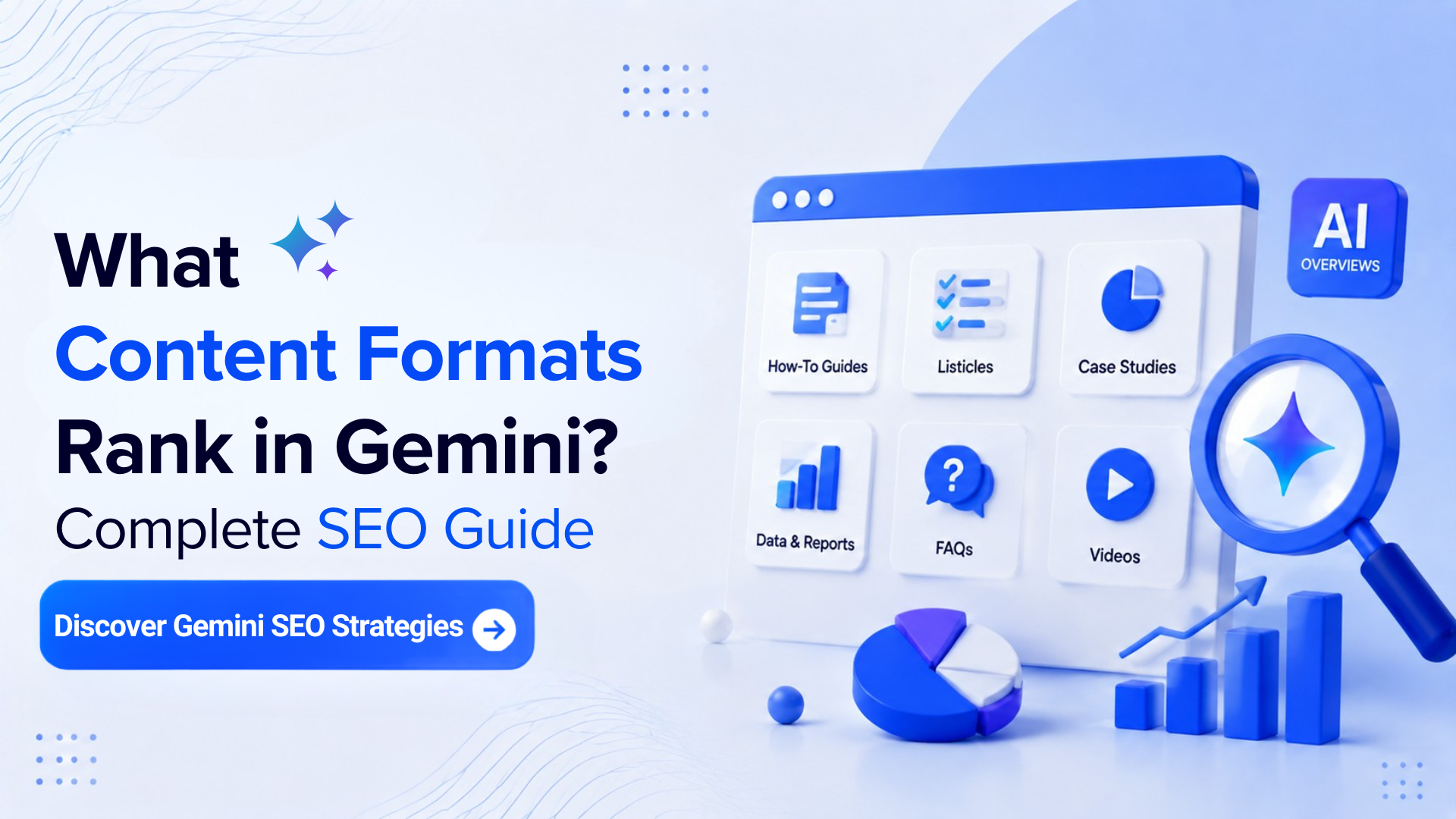
What Content Formats Rank in Gemini
Content formatted in a logical Q&A, concise definition, and/or comparison table format generally does well. Content that can be drawn a clear conclusion from—rather than text that you have to read the whole article to get a clear idea of the gist of it—appears to delight Gemini’s attention.
This is where schema implementation has a bit more weight since Google relies heavily on the structured data ecosystem for its services. This also includes a lot of the strategies covered in our post about making ChatGPT visible as a search engine.
Structured Data Gemini Prefers
Beyond basic organic schema types, Gemini appears to respond well to FAQ schema, HowTo schema, and Article schema with clear author and publication information—all signals that reinforce both content clarity and E-E-A-T. This connects to broader local visibility strategy too, since local SEO for ChatGPT and Gemini both depend on accurate, well-structured business and location data being available for these systems to pull from.
Step-by-Step Agency Checklist for Gemini Optimization
- Audit existing schema markup across key client pages, adding FAQ and HowTo schema where relevant
- Restructure top-performing content into clearer, more directly answerable formats
- Ensure content freshness — update key pages regularly rather than leaving them static
- Strengthen author and business information for E-E-A-T signals Gemini can reference
- Confirm traditional Google Search visibility is solid, since Gemini draws from the same underlying index
This checklist works best as an addition to existing traditional SEO and broader AI visibility strategy, rather than a separate, standalone effort. Our GEO/AEO/AIO service page covers how agencies can build this into a unified strategy spanning traditional search, Gemini, ChatGPT, and other AI platforms together.
FAQs for Rank in Gemini
How do I optimize for Gemini search specifically?
Focus on strong schema markup, clear question-and-answer content structure, and solid traditional Google Search visibility, since Gemini draws heavily on Google’s existing index and structured data.
What are the main Gemini AI search ranking factors?
The selection and surfacing of content seem to be influenced by structured data, answers that are direct and well-organized, site authority, and freshness of content.
Would optimizing for Gemini be different to optimizing for ChatGPT?
Yes. Schema and traditional SEO techniques have more weight when it comes to Gemini, as it relies much more on Google’s search infrastructure and structured data, whereas ChatGPT employs a different way to retrieve the data.