









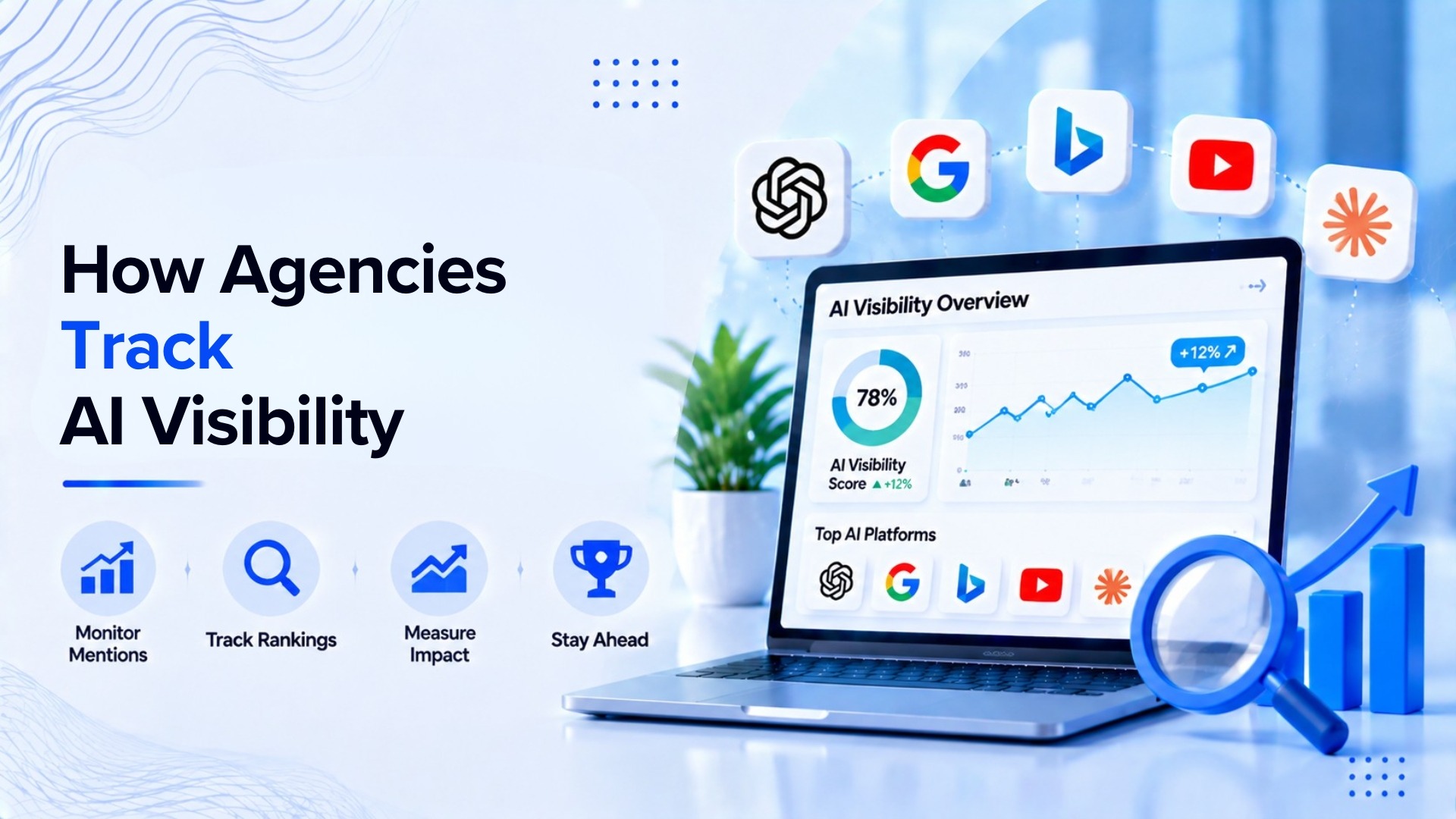
How Agencies Track AI Search Visibility for Clients in 2026
Brand Visibility in ChatGPT our client asks, “Do we show up when people ask ChatGPT?” Your rank tracker has no answer. It’s this gap that makes AI visibility tracking for agencies a crucial skill this year. How to measure it, how it will help, and how to explain it to clients who are still in Google.
Key Takeaways
- Agency AI visibility tracking is not ranking in single positions; it is ranking mentions, citations, and share of voice, ranking for how accurate their mentions and citations were.
- A starting point is 25 to 50 questions, tested many times with ChatGPT, Gemini, and Perplexity using a format similar to that of a customer.
- Leads- or traffic-based before-and-after numbers are simple to show to clients, and they accept new reports.
AI Search Visibility will require a different method and plan of tracking than regular SEO.
Google gives you a fixed spot. Your page is number 3, and it stays there until something changes. AI engines aren’t like that. It’s this gap that makes AI visibility tracking for agencies a crucial skill this year. How to measure it, the tools that will work, and how to communicate to the clients who live in Google.
AI search visibility involves tracking and strategies that are different from conventional traditional SEO.
Hence, AI search tracking centers around three questions rather than rank.
Is the brand mentioned? Is the client’s site cited as a source? Is the brand described correctly? To understand why engines pick certain brands, read our AI Search Ranking Factors post.
Key Metrics for How to Measure AI Visibility in 2026
If you’re asking how to measure AI visibility, begin with five numbers:
- Mention rate: the share of test questions where the brand appears
- Citation rate: how often the client’s website is linked as a source
- Share of voice: the client’s mentions compared with competitors
- (Right facts, positive tone)
- AI referral traffic: Traffic that is generated through AI platforms.
These work as ChatGPT visibility metrics, and they apply to other engines too. For Gemini visibility, also check Google’s AI Overviews and AI Mode, since they appear inside regular search results.
A quick warning: answers change between runs. Test each question a few times, and rate trends over multiple weeks, not by one shot of the cartridge at a time.
A quick warning: answers change between runs. Test each question several times, and judge trends over weeks, not one-off snapshots.
Tools Agencies Use to Track ChatGPT, Gemini, and Perplexity Visibility
You can start for free. HubSpot’s AEO Grader and Ahrefs’ AI Visibility: The checker gives a fast first look. For ongoing tracking, paid tools run your questions on a schedule:
- Peec AI: focused tracking with sentiment and competitor views, roughly €85 to $95 a month
- Profound: deeper analytics, starting around $99 a month (lower tiers may cover fewer engines)
- Semrush AI Toolkit: tracking inside a platform many agencies already use, about $99 a month per domain
- Ahrefs Brand Radar: a large prompt database, from roughly $199 a month per platform index
- Otterly is a lower-cost option that will cost approximately $29 per month.
The price is continually changing, so be sure to find the latest prices. Several agencies also perform a few manual checks, as each tool checks answers slightly differently.
How do you want to get started? What is your starting point?
A baseline is a reference point to compare previous results with later ones
- Create up to 25 to 50 questions about customers such as “best accountant for freelancers” or “emergency plumber near me.”
- Try each of the prompts in ChatGPT, Gemini, Perplexity, and Google AI Overviews multiple times.
- Write it down: did he/she say something, or did he/she not say something? Did he/she cite or did he not cite? Did he/she show up or did he not show up? Was the factual information correct or not.
- Consider the basics like having a reliable listing for the business, schema, and discussion on trusted third parties.
- Save screenshots. They prove progress later.
Our AI Visibility Audit post covers each step in more detail.
How to Report AI Search Performance to Clients Who Only Know Google Rankings
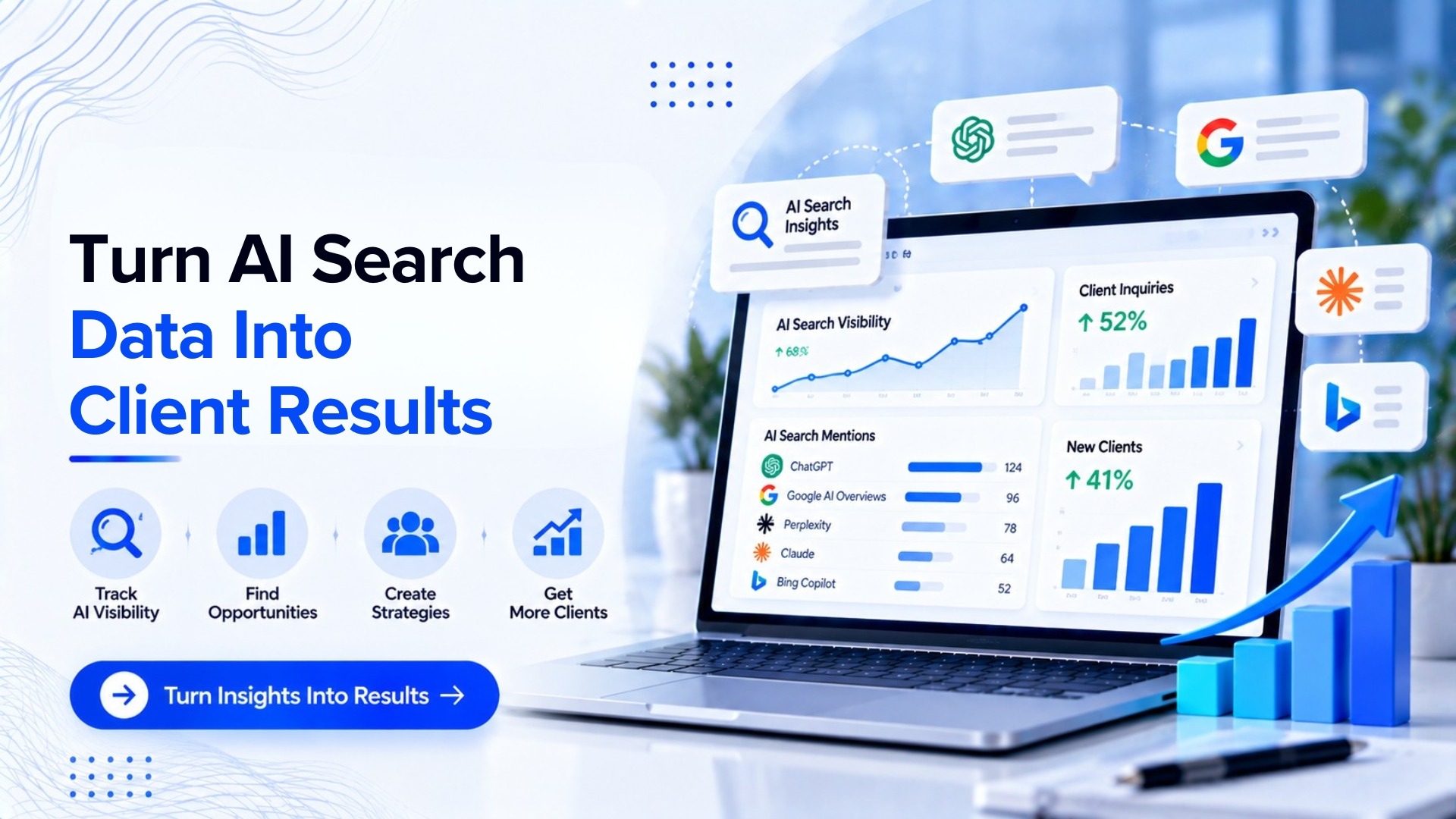
Clients like rank reports because they’re easy. Don’t fight that habit. Translate it. Describe how AI systems suggest brands—similar to a close friend—and demonstrate the changes over time.
Use something like this: For last quarter, your brand was seen in 4 out of 40 customer questions; this quarter, in 11 out of 40 customer questions, and 2 answers now include your site.
The key to good AI search performance reporting is simply these numbers, before/after views, and actual screenshots.
Building an AI Visibility Reporting Dashboard for Agency Clients
Keep the dashboard simple. Google Looker Studio works well because it can pull in tool exports, Search Console, and analytics together. Include these panels:
Panel | What it shows |
Mention the rate trend. | Share of test questions that mention the brand by the AI platform. |
Citation tracker | Which pages get cited, and where |
Competitor share of voice | Client vs. top three competitors |
Accuracy log | Wrong or outdated facts to fix |
AI referral traffic | Visits and conversions from AI sources |
Work completed | What your team shipped this month |
Refresh it monthly with the same question list, so trends stay fair. For the strategy behind these numbers, see our GEO Complete Guide.
FAQ for AI visibility tracking for agencies
What is the way to check the appearance of my client in AI search?
Test a static set of customer questions with ChatGPT, Gemini, Perplexity and Google AI Overviews. Note if the brand is mentioned or cited and repeat the test several times, as answers are different.
What are the tools that monitor and keep track of ChatGPT rankings?
There is no true “ranking” that can be tracked with a tool. Peec AI and Profound track ChatGPT mentions and citations, as well as AI engine mentions and citations from other platforms such as Profound, Semrush, Ai-bank, and Ahrefs.
How often should agencies report AI visibility?
Monthly works well. It matches the rhythm clients know from SEO reports and gives AI answers enough time to show a real trend.