










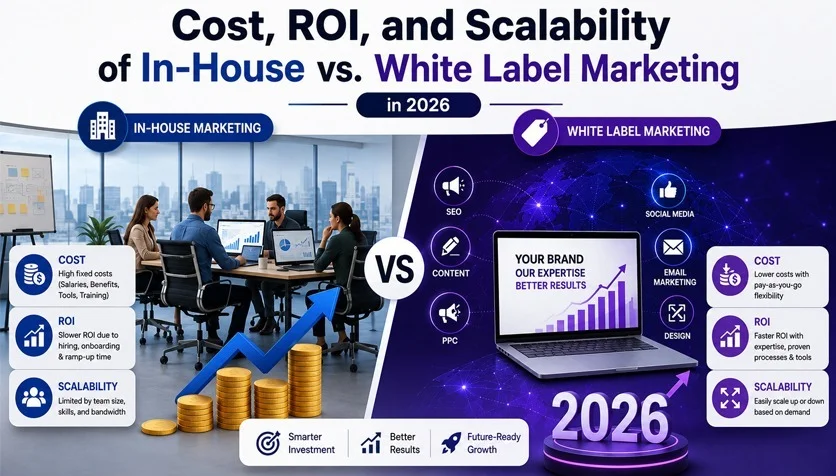
White label marketing is typically less expensive and simpler to expand than assembling a whole in-house marketing group, especially for new companies, little enterprises, and developing agencies. White label administrations can yield a higher return on investment for companies seeking quicker campaign execution, less running costs, and access to knowledgeable experts.
This article compares in-house versus outsourced marketing teams for agencies, startups, and company owners in 2026.
White Label vs. In-House Marketing
White Label Promotion
- A smaller initial outlay
- Hiring an internal staff is not necessary
- Quicker scalability
- Immediate access to specialists
- Typically, marketing tools are offered
- Quicker campaign implementation
- Ideal for startups, agencies, and expanding companies
- Moderate command over procedures and activities
In-House Marketing
• Increased setup and running expenses
• Needs hiring and educating staff
• A slower rate of scaling
• Restricted to your internal team’s competence
• Spending separately on marketing tools and software
• More authority over communication and branding
• Better for big businesses with steady budgets
• Increased internal brand awareness over time
What differentiates In-House Marketing from White Label Marketing?
White-Label Marketing is the process of outsourcing marketing services to an external team that operates under your brand’s name.
Building and leading your own internal staff is known as “in-house marketing.”
For an example:
- A digital organization may contract with a white-label vendor to handle SEO, PPC, or content creation.
- A big company could have its own paid promoting specialist, creator, strategist, and SEO supervisor.
The primary distinction is due to:
- Price
- Managing a team
- Scalability
- Proficiency
- Velocity
Why businesses embracing white label marketing in 2026?
Businesses are shifting to external since Digital Marketing has become more expensive and specialized.
According to current industry reports:
- The cost of hiring qualified marketers has increased dramatically.
- Monthly subscriptions are now necessary for marketing tools.
- SEO, PPC, social media, AI optimization, analytics, and content are all necessary for businesses.
- Small teams frequently find it difficult to efficiently manage every channel.
White-label services assist businesses in avoiding:
- The expense of hiring
- Training for employees
- The cost of software
- Extended rounds of onboarding
Businesses may instantly access a full external staff rather than recruiting five to seven professionals inside.
What Makes White Label Marketing More Expandable?
Businesses may expand without hiring more employees thanks to white-label marketing.
Rather than:
- Recruiting new workers
- Educating groups
- Growing operations
You just: Expand the number of client accounts
- Boost the amount of services
- Use your provider to expand marketing.
For instance
Internal delivery may be a challenge for a small business managing ten SEO clients.
Alongside a white-label partner:
- The agency can grow to serve more than fifty clients.
- Delivery is constant.
- Sales and client relationships are the agency’s main priorities.
This is one of the reasons why a lot of businesses employ outsourced fulfillment techniques in order to expand faster.
Which Investment Offers greater Return on Investment?
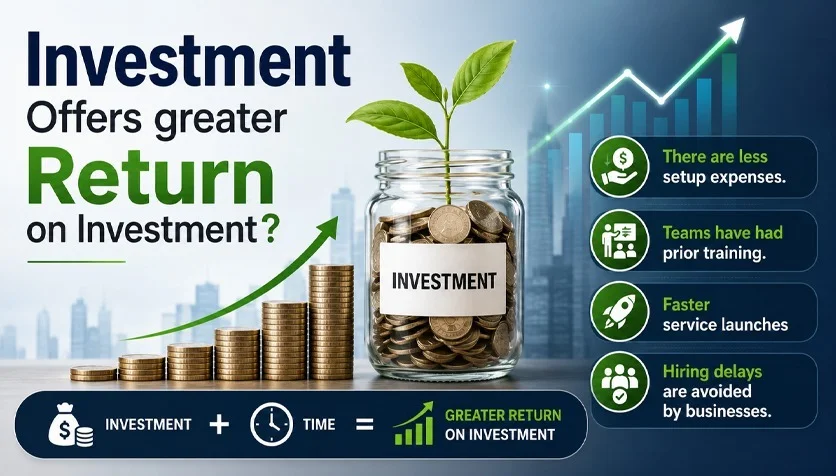
ROI is influenced by operational organization, funding, and corporate objectives.
But white label marketing frequently yields a quicker return on investment because.
- There are less setup expenses.
- Teams have had prior training.
- Faster service launches.
- Hiring delays are avoided by businesses.
Long-term ROI may be higher for internal teams if:
- The business’s income is steady.
- Consistency in branding is essential.
- Internal cooperation is required.
- There are extensive marketing initiatives.
Easy ROI Comparison
ROI for White Label Marketing
- Robust short-term return on investment
- Reduced risk in operations
- The opportunity to expand more quickly
- Excellent adaptability for expanding services
- Lower expenses for recruiting and training
ROI for In-House Marketing
- Improved long-term brand management
- Increased internal cooperation
- More hands-on campaign management
- Increased operating expenses
- A slower onboarding and scaling procedure
What Are White Label Marketing’s Main Benefits?
1. Reduced Operating Expenses
Companies save money on infrastructure and full-time salaries.
2. Quicker Delivery of Services
Teams with experience may start campaigns fast.
3. Accessibility of Expert Professionals
Ad managers, developers, designers, and SEO specialists don’t need to be hired individually.
4. Simpler Scaling
Without increasing internal payroll, agencies may grow their clientele.
5. Less Work for Management
Recruitment and employee monitoring take less time.
What Drawbacks Does White Label Marketing Have?
Not every company can benefit from White-Label Marketing.
Possible disadvantages consist of:
- Reduced direct control
- Delays in communication
- Reliance on outside suppliers
- Variations in quality between suppliers
For this reason, picking the correct partner is important.
Companies ought to assess: Systems for reporting
- The process of communication
- Time of turnaround
- Level of experience
- Proficiency in the industry
When Is In-House Marketing More Sensible?
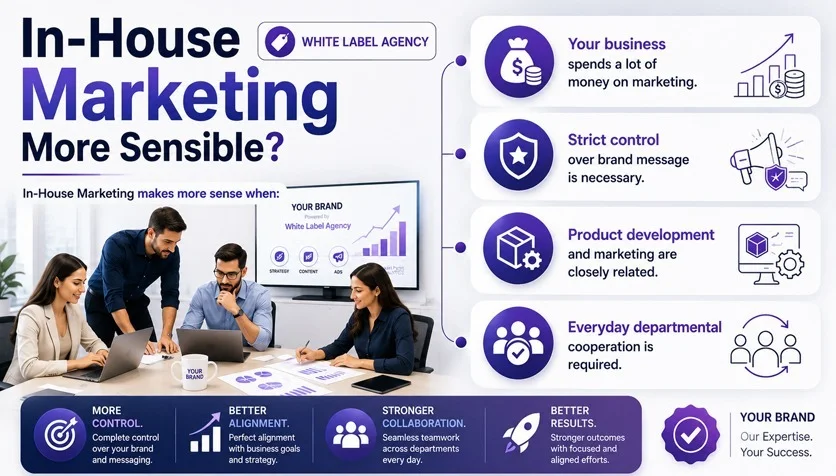
- Your business spends a lot of money on marketing.
- Strict control over brand message is necessary.
- Product development and marketing are closely related.
- Everyday departmental cooperation is required.
Because they can make significant investments in long-term operations, large companies frequently choose internal teams.
Can Companies Use Both Models Together?
Indeed. A hybrid marketing approach is used by many prosperous businesses.
For instance:
- The strategy remains internal.
- SEO fulfillment is contracted out.
- PPC advertising is handled by third parties.
- A portion of content creation is outsourced.
This strategy provides companies with:
- Improved scalability
- Cheaper prices
- Increased internal control
Do you require quick scaling?
White-label products typically grow more quickly.
Is the budget a significant issue?
Operating costs are frequently lowered by outsourcing.
Do you require total control?
Stronger control and communication are offered by internal teams.
Are you having trouble hiring experts?
White-label suppliers already have qualified professionals on hand.
Does your workload fluctuate?
In both hectic and slack times, outsourcing provides more freedom.
Real-World Example: Comparing Agency A’s Growth with the In-House Model
- Employs five people
- Has delays in hiring
- Increased payroll costs
- Agency B’s White Label Model has a slower client onboarding process
- Makes use of external fulfillment
- Concentrates on acquiring clients
- Has less overhead and scales more quickly.
- Quickly expands services
After a year, Agency B may develop more quickly since there are less operating restrictions.
FAQ
Does internal marketing yield better outcomes?
Not all the time. Systems, execution procedures, and team knowledge all affect quality.
Can white-label services be used by small agencies?
Indeed. White-label suppliers are used by many small firms to grow without employing huge staff.
For long-term growth, which model is superior?
It relies on the objectives of the company. While internal teams provide greater brand control, white-label solutions scale well.
Does a hybrid marketing approach work?
Indeed. For increased efficiency, many businesses combine internal planning with outsourced implementation.
Both in-house and white-label marketing have special benefits.
If the following is your top priority:
- Scalability
- Reduced operating expenses
- Quicker execution
- Availability of specialists
White-Label Marketing is therefore frequently the superior option.
If you are concentrating on:
- Total command
- Internal cooperation
- Consistency of the brand across time
An in-house team could perhaps be more appropriate.
In 2026, a hybrid approach that combines internal strategy with outsourced execution for optimum efficiency and ROI is the most practicable alternative for many firms.